
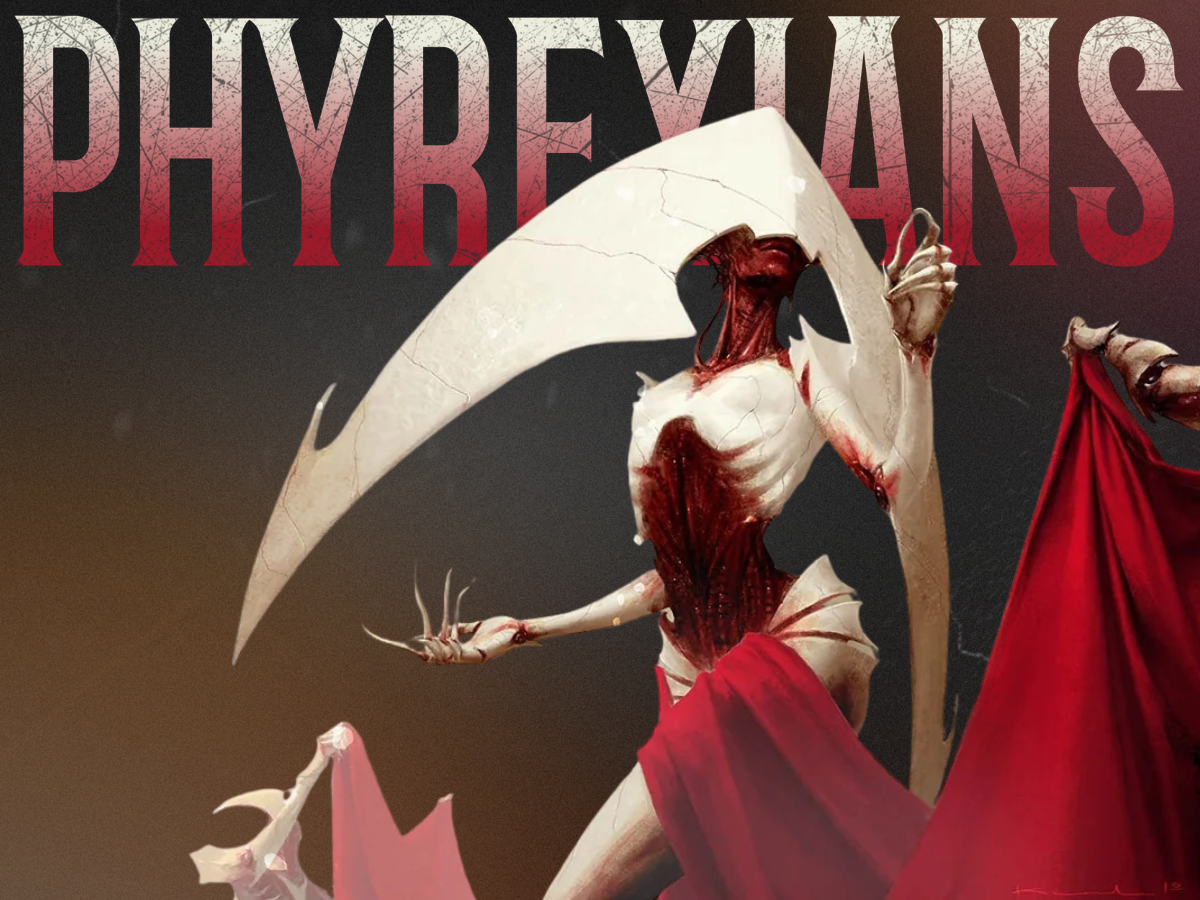
Phyrexians in Commander
Elesh Norn, Grand CenobiteElesh Norn, Grand Cenobite | Art by Igor Kieryluk
Phyrexians are the big bad of Magic. Well, one of a few, up until the conclusion of March of the Machine. For decades, old Phyrexians, like Yawgmoth and Elesh Norn, were the far-off scourge of the Multiverse that drew ever closer. A living disease of metal and oil, corrupting all it came in contact with.
So how do Phyrexians play in Commander? What are their strengths and weaknesses? And how do you win with Phyrexians in Commander?
This EDHREC Guide is here to answer all of these questions.
What Are Phyrexians?
Phyrexians as a concept in Magic lore have existed for significantly longer than Phyrexians existed mechanically.
The first mechanical Phyrexian — as in, a card with the word "Phyrexian" appearing on the type line — was Vorinclex, Monstrous RaiderVorinclex, Monstrous Raider, as introduced in Kaldheim. That said, creatures that would later be a subject of errata and classified as Phyrexians were released as early as Antiquities. Many of these like Phyrexian GremlinsPhyrexian Gremlins had "Phyrexian" in their name, clearly signposting that they were intended to be a part of the creature type. Others aligned with the aesthetics and lore of Phyrexians, such as Priest of YawgmothPriest of Yawgmoth.
There are also creatures which are Phyrexian from a lore perspective but have no Phyrexian creature type, such as Consecrated SphinxConsecrated Sphinx. Despite referencing Phyrexia in their flavor text, art, and name, these are not Phyrexians and have no mechanical tie-in to the creature type.
This may due to a variety of reasons, from conscious choices to put game balance above the narrative, to simple oversights. Either way, they're few and far between while holding abilities that still synergize with other Phyrexians.
Early Phyrexians were firmly -aligned as a result of being servants of Yawgmoth. More modern releases have involved Phyrexians of all colors with a strong leaning into colorless and artifacts, as led by Elesh Norn in her invasion of the Multiverse. This includes colorless Phyrexians, mostly as represented in tokens. And for their entire history, Phyrexians have had deep ties to artifacts.
Pros and Cons of Playing Phyrexians in Commander
Toxic Strategies
Yawgmoth's Phyrexia involved a lot of creatures with infect, which causes a creature to deal damage to other creatures in the form of -1/-1 counters and to players in the form of poison counters. When an opponent has ten or more poison counters, they lose the game regardless of their life total. Infect has mostly been phased out as a keyword in favor of wither and toxic, where wither applies -1/-1 counters to creatures without applying poison counters, and toxic applies a static amount of poison counters without inflicting -1/-1 counters.
Modern Phyrexians take the toxic keyword in stride, leveraging not only high toxic values to apply up to eleven poison counters to an opponent at a time, but also bringing out many tokens each with toxic 1. Such Phyrexians also utilize the "corrupted" ability word, granting access to more powerful effects if an opponent has three or more poison counters.
Phyrexians of all kinds and from across Magic's history have also been tied to proliferating, most often in conjunction with forcing opponents to lose with poison counters.
Fast Mana
Phyrexians have an odd relationship with mana in-universe, due to their artificial and corrupting nature. This has manifested in a few ways mechanically, such as allowing for explosive generation at a cost. That cost might be sacrificing a creature with Phyrexian AltarPhyrexian Altar or being specifically -aligned with Dark RitualDark Ritual.
Many spells and activated abilities also utilize phyrexian mana. Phyrexian mana allows you to either pay its corresponding mana cost or spend two life. It rarely features in the casting cost for newer Phyrexian spells, but the various compleated planeswalkers feature the additional compleated ability word. Paying a compleated planeswalker's phyrexian mana by spending life reduces the amount of loyalty counters it enters with.
Spawning
Phyrexians have a variety of ways to create more Phyrexians, often with a specific function they fulfill. Phyrexian Mites are 1/1s with toxic 1, and show up regularly alongside 1/1 Insects with infect. The incubate keyword creates an artifact with a number of +1/+1 counters that can transform into a 0/0 Phyrexian. The living weapon keyword allows for equipment to enter the battlefield (ETB) attached to a 0/0 Phyrexian Germ. Multiple other effects produce other Phyrexian creature tokens of varying power and toughness.
The throughline between all of these is that they tend to be Phyrexian creature tokens and are often associated with artifacts. Some are artifact creatures while others directly work alongside artifacts. Overwhelmingly, Phyrexian token generation benefits from proliferation in its ability to increase poison or +1/+1 counters.
Starting the Plan
Phyrexians are reliant upon being able to build up a force to create momentum. This is most acutely felt in its reliance on poison counters, +1/+1 counters, -1/-1 counters, and other incremental mechanics. Corrupted abilities don't function unless you've already had the chance to build up your opponents' poison counters. Proliferating can only enhance what you have, not make something new.
The main workaround for this is to invest in getting a few poison counters out across your opponents early, allowing you to later proliferate them and trigger corrupted abilities. Many Phyrexian creatures are cheap, disposable fodder with toxic 1 or a 1/1 with infect that can get a single poison counter on an opponent. Similarly, being aggressive to get out creatures to be built up with +1/+1 counters or hitting -1/-1 counters on a threat early will allow you to compound on that later.
Phyrexians require a surprising amount of early-game aggression to set up mid or late-game strategies.
Costs on Costs
Despite their ability to provide returns on mana, many Phyrexians are quite expensive. This might be due to requiring a lot of mana to cast or it may involve an additional effect in order to keep the creature on the field. These vary based on when the card was released, with older cards usually being more punishing to represent the more oppressive and uncaring industrialization of Old Phyrexia.
Even still, Phyrexians will regularly require you to spend all of your mana, a fair bit of life, and potentially some of your permanents or cards in-hand in order to field them effectively. Your willingness to do so should be based on what the tempo of the game is at that time, where the more threatened you are, the more conservative you should be in your resource expenditure. You can create many tokens or cast many spells that will be able to hold their own in combat, but you'll need to pace yourself in actually bringing them to the battlefield.
It's a matter of balancing that measured pace with the early-game aggression to set up your counters for later.
The Best Phyrexian Commanders
Atraxa, Praetors' VoiceAtraxa, Praetors' Voice
Atraxa, Praetors' VoiceAtraxa, Praetors' Voice is the 4th most-popular commander at the time of this guide's writing. It is a 4/4 with flying, vigilance, deathtouch, and lifelink that has you proliferate at the beginning of your end step.
Phyrexians, of course, love proliferation for all the reasons described above. But this applies to more than just +1/+1 or poison counters. Many Phyrexians have oil counters, a resource that usually can't be replenished and acts as a limiter on some very powerful abilities. There was a cycle of the various Phyrexian Praetors which can transform into sagas, which can then be rapidly-advanced via proliferation at the end of turn.
Then there are the synergies Atraxa has with any other positive counter you're creating or negative counter you're inflicting. It ramps up a vast number of game plans while also being a very strong set of keywords.
Brimaz, Blight of OreskosBrimaz, Blight of Oreskos
Brimaz, Blight of OreskosBrimaz, Blight of Oreskos is a 3/4 that allows you to incubate X each time you cast a Phyrexian creature or artifact spell, where X is its mana value. Incubate X allows you to create an Incubator token with X +1/+1 counters on it, where you can spend to transform it into a 0/0 Phyrexian artifact creature. Brimaz also has you proliferate during your end step if a Phyrexian you control died that turn.
Brimaz has an inferior ability to Atraxa, giving the same outcome under a more narrow set of circumstances and with a stricter color identify. However, consistent incubate triggers allows you to create disposable Phyrexians to trigger this ability just about every turn. You can utilize self-sacrifice or risky plays to force the proliferate trigger, which in turn increases the number of +1/+1 counters on your Incubators.
It requires more finesse to pilot properly than something like Atraxa, but it feeds into the gameplay strategy of "an overwhelming tide of ever-growing tokens" much easier.
Ixhel, Scion of AtraxaIxhel, Scion of Atraxa
Ixhel, Scion of AtraxaIxhel, Scion of Atraxa is a 2/5 with flying, vigilance, and toxic 2. It also has a corrupted ability where during your end step, you may exile the top card of the library face down of each opponent who has three or more poison counters. You may cast those cards so long as they remain exiled by spending mana of any color to cast them.
Ixhel's ability is reliant on being able to get at least one opponent to three poison counters, something achieved simply enough via its flying and toxic 2 keywords. Two turns of attacking an opponent without fliers or a single turn of attacking alongside some Mites can set it up nigh immediately.
The biggest strength of Ixhel is ultimately reliant on what cards you exile from your opponents, not just in the ability to cast them but also to deny your opponents. This can reasonably disrupt engines just as easily as it can snatch a high-value beatstick, with what specifically is the most useful to you changing based on the state of the game.
Vishgraz, the DoomhiveVishgraz, the Doomhive
Vishgraz, the DoomhiveVishgraz, the Doomhive is a 3/3 with menace and toxic 1 that gets +1/+1 for each poison counter your opponents have. It also has an ETB to create three 1/1 Phyrexian Mites with toxic 1 and which cannot block.
Vishgraz occupies an odd position in being better at one win condition while making progress towards another. It gets strong in power as your opponents gain more poison counters. Toxic 1 doesn't scale, meaning it will never deal more than one poison counter at a time without external interference. Therefore, Vishgraz works best at breaking through defensive lines and clearing blockers, since menace forces opponents to lose two blockers at a time.
The scaling power does mean Vishgraz can reasonably take out an opponent via commander damage, though that's a secondary threat to the poison counter production you'll be inflicting.
Elesh NornElesh Norn
Elesh NornElesh Norn is a 3/5 with vigilance. Whenever a source an opponent controls deals damage to you or one of your permanents, that opponent loses 2 life unless they pay . This is a consistent tax your opponents have to pay to deal damage to you, draining their mana or life over time. is no stranger to taxes via enchantments, meaning you can quite readily set up multiple layers of protection before any opponent takes aggressive action against you.
Elesh Norn can also transform into a Saga by paying and sacrificing three other creatures. The first chapter has you incubate 2 five times and then transform all Incubator tokens you control. This gives you a minimum of five 2/2 Phyrexian artifact creatures. The next chapter grants all of your creatures +1/+1 and double strike until end of turn, making this likely at least five 3/3 Phyrexian artifact creatures with double strike. The third chapter destroys all other permanents except for artifacts, lands, and Phyrexians before transforming back into Elesh Norn.
Assuming you have the mana, you can then transform Elesh Norn back into the Argent Etchings by sacrificing those Phyrexians it created in its previous incarnation.
Glissa, Herald of PredationGlissa, Herald of Predation
Glissa, Herald of PredationGlissa, Herald of Predation is a 3/5 that allows you to choose one of a few options at the beginning of combat on your turn. You can incubate 2 twice, transform all Incubator tokens you control, or grant Phyrexians you control first strike and deathtouch until end of turn.
The expected loop is to spend one combat to incubate 2 twice, a second to transform them, followed by a third combat to capitalize off your Phyrexians. This isn't a necessary order, though, and can better be thought of as an indication of how far in the game you are.
In the early game you'll want more Incubator tokens while in the mid-game you'll be producing enough that transforming them for free provides more value. First strike and deathtouch is a potent combination for all your Phyrexians to get and can reasonably be used any time during the game, though will gain its greatest value should you have many tokens generated.
Elesh Norn, Mother of MachinesElesh Norn, Mother of Machines
Elesh Norn, Mother of MachinesElesh Norn, Mother of Machines is a 4/7 with vigilance that comes with two effects. If an ETB triggers an ability of a permanent you control, that ability triggers an additional time. Further, permanents ETB don't trigger abilities of permanents your opponents control.
This effectively makes any ETB effect only positively impact you and then doubling it, granting you twice the token generation or poison counter infliction or counter production while denying your opponents. The ability to shut down ETB effects of your opponents is powerful on its own, but Phyrexian ETB effects rely on quantity. This Elesh Norn gives you a much more consistent and lower-cost method of increasing how many of those ETB effects you can support.
Skrelv, Defector MiteSkrelv, Defector Mite
Skrelv, Defector MiteSkrelv, Defector Mite is a 1/1 with toxic 1 that can't block. However, for one white phyrexian mana, you can tap Skrelv to grant another creature you control toxic 1, hexproof from a color of your choice, and becoming unable to be blocked by creatures of that color until the end of turn.
Skrelv functions as a support piece, opening up more valuable creatures to slip by defenders. The fact its ability can be triggered by spending life means you'll be doing that a lot, with Skrelv's cheap cost making up for its low toughness. Expect Skrelv to regularly be removed from the battlefield only to come back a turn later, even if it's never attacking. What matters is pairing Skrelv with other Phyrexians you want to deal direct damage, be it high-power creatures with infect or a utility piece that provides other benefits than direct damage.
Staples for Phyrexian Commander Decks
Blightbelly RatBlightbelly Rat
Blightbelly RatBlightbelly Rat is a 2/2 with toxic 1 and lets you proliferate upon dying.
At such a low cost, this is a fantastic way to get out early-game poison counters by attacking before an opponent can effectively protect themselves. It still has utility in the late-game by its death trigger, meaning it works great as sacrifice fodder for your other activated abilities.
Necrogen RotpriestNecrogen Rotpriest
Necrogen RotpriestNecrogen Rotpriest is a 1/5 with toxic 2, meaning it actually inflicts more poison counters upon damaging an opponent than damage. On top of that, any time a creature you control with toxic deals combat damage to a player, they get an additional poison counter. It can also grant creatures you control deathtouch until end of turn if they already have toxic.
This scales most effectively with Phyrexian Mite swarms, doubling the amount of poison counters each token inflicts. It also allows your low-power creatures to take blockers out with them via deathtouch, opening up your opponents' defenses for future turns. And with a toughness of 5, the Rotpriest functions best as a defender supporting your other creatures with its additional poison counter affect. Just be aware that the effect specifies creatures with toxic, not any other way of inflicting poison counters such as infect.
Norn's ChoirmasterNorn's Choirmaster
Norn's ChoirmasterNorn's Choirmaster is a 5/4 with flying and first strike which has you proliferate each time your commander ETB or attacks.
Proliferate is the name of the game for Phyrexians across multiple different strategies. Given how central your commander will be to whichever playstyle you select, you'll be casting them as often as possible. Many Phyrexian commanders are decent combatants, meaning you'll get potentially a proliferate trigger each turn before even considering your commander's abilities. This rapidly accelerates disruption of your opponents' creatures, growth of your own, or poison counter accumulation.
Norn's WellspringNorn's Wellspring
Norn's WellspringNorn's Wellspring allows you to scry 1 and put an oil counter on it whenever a creature you control dies. Then you can tap it for and remove two oil counters from it to draw a card.
You'll have access to a number of disposable Phyrexians, meaning you'll be gaining oil counters regularly even without sacrificing your creatures. This then means that you get a free card draw per turn for only which shouldn't get in the way of your other spells to cast. Once you get a few oil counters on it, proliferation may even continue the oil generation by itself, meaning you can still gain benefits by playing defensively.
Throne of GethThrone of Geth
Throne of GethThrone of Geth allows you to tap it and sacrifice an artifact to proliferate.
Your artifact creature tokens are going to be the main source of your proliferation here, sacrificing a 1/1 or 2/2 to enhance all of your other creatures. Generally, you won't want to be sacrificing your nontoken artifacts, as their value will be more permanent than a proliferate trigger, though you have the option should that create an opening for you. An opponent at eight or nine poison counters, a centerpiece creature one -1/-1 token away from being destroyed, or a surge of +1/+1 counters that will allow you to deal lethal damage are all cases to sacrifice your most powerful artifacts.
That just generally won't be your first choice, given how accessible artifact tokens are to Phyrexians.
Norn's AnnexNorn's Annex
Norn's AnnexNorn's Annex prevents creatures from attacking you or planeswalkers you control unless their controller pays 2 life or for each of those creatures.
This is a standard tax to ward off attacks from opponents, but what sets it apart is the fact it involves two phyrexian mana in its cost. Instead of casting it for , you will usually be casting it for and 4 life. This eases the burden on your mana production and pushes forwards the turn you can reasonably play it on. Most players will choose to pay the life in the early game, meaning you can get some free damage on any aggressive opponents.
Skrelv's HiveSkrelv's Hive
Skrelv's HiveSkrelv's Hive causes you to lose 1 life and create a 1/1 Phyrexian Mite with toxic 1 that can't block at the beginning of your upkeep. It also has a corrupted ability to grant your creatures with toxic the lifelink keyword.
The life loss of the Hive is minimal, particularly once you manage to get lifelink on your toxic creatures. At minimum, your Mites will be paying for themselves assuming they deal damage once and then die. Ideally, you're able to overwhelm an opponent with enough Mites that they can survive more than one combat, giving you a surplus of life as well as inflicting multiple poison counters. They rely on other support like the Necrogen RotpriestNecrogen Rotpriest in order to make them truly threatening, but even passive token generation puts you in a more advantageous position for cheap.
Phyrexian ArenaPhyrexian Arena
Phyrexian ArenaPhyrexian Arena causes you to draw a card and lose 1 life at the beginning of your upkeep.
This doubles your consistent card draw at the cost of a single life lost each turn, which is more than worth it. Any amount of life gain in your library will allow you to offset this, as even though it's cheap enough to cast early, you likely won't lose a significant amount of life from it. It's found a home in decks completely unrelated to Phyrexian typal due to its consistent, versatile value that just keeps giving. Unless you know an opponent can remove it or you're on the verge of losing all your life, there's no reason not to cast it.
Norn's DecreeNorn's Decree
Norn's DecreeNorn's Decree causes any opponent who attacks you to gain a poison counter. It also allows any player to draw a card when they attack a player who has one or more poison counters.
This acts as another tax, giving a limit on how many times an opponent can attack you before they lose the game. This is potent enough to ward off throwaway combats, where the opponent is attacking you simply to attack someone, but won't stop a concerted effort to shut you down as a threat.
However, Norn's Decree also encourages the other players to attack whoever has attacked you or who you're focusing in order to draw cards. This is indirect form of protection lowers you in the priority without directly shutting down any hostile action, giving decent sustainability while retaining plausible deniability.
Experimental AuguryExperimental Augury
Experimental AuguryExperimental Augury allows you to look at the top three cards of your library, put one in your hand and the rest on the bottom of your library in any order, and then proliferate. All for !
There are more repeatable ways to proliferate, meaning while this is a useful function it's mostly used in conjunction with being able to thin out the top of your library. You get to reorganize the next few cards you would draw which could be very good or middling depending on how your cards are stacked. That's where the consistent value of proliferating makes this card valuable, while the potential to score a great draw enhances it further.
Phyresis OutbreakPhyresis Outbreak
Phyresis OutbreakPhyresis Outbreak gives each opponent a poison counter, then gives each creature your opponents control -1/-1 until end of turn for each poison counter its controller has.
This can function as a reasonable board wipe for anything mid-toughness or lower, assuming it's used in the mid to late-game. It's great for removing chaff blockers and opening up the defenses of your opponents who have five or six poison counters, securing a few hits with Mites or other tokens with toxic to close out their loss. But it's also cheap enough to find value in the early game, clearing 1/1 tokens and some utility creatures even if an opponent has no poison counters prior to its casting.
Drown in IchorDrown in Ichor
Drown in IchorDrown in Ichor gives a creature -4/-4 until end of turn and has you proliferate.
A more targeted form of Phyresis OutbreakPhyresis Outbreak, it finds its greatest value in the early game when you may be struggling to overcome a mid-range blocker or need an extra poison counter to hit the corrupted threshold. It can also combo with other -X/-X effects in order to push a creature over the edge, such as by compounding with one ore more -1/-1 counters to spike the reduction to a creature's toughness. If there are no other good targets available, you can always cast it to remove a weak creature an opponent controls just for the proliferate trigger.
Each of the planeswalkers listed below have the "compleated" ability word, which relates to their cost. For compleated planeswalkers, their starting loyalty counters is reduced by two for each phyrexian mana paid with life.
Ajani, Sleeper AgentAjani, Sleeper Agent
Ajani, Sleeper AgentAjani, Sleeper Agent begins with 4 loyalty counters, or 2 if cast using life. Its abilities are as follows:
+1. Reveal the top card of your library. If it's a creature or planeswalker, put it in your hand. Otherwise, you may put it on the bottom of your library. This is effectively a public scry 1 that provides you the ability to add a creature or planewalker to your hand. This is good for ensuring you're getting value from your next card drawn and potentially can fast-track the casting of a powerful Phyrexian.
-3. Distribute three +1/+1 counters among up to three target creatures, which also gain vigilance until end of turn. Particularly after getting a useful creature onto the battlefield the prior turn using Ajani's +1 ability, this allows you to set up growth that will later be proliferated. Vigilance for a turn allows you to attack without leaving yourself vulnerable, though your greatest value will be ensuring all of your creatures have at least one +1/+1 counter. Sometimes even your 1/1 tokens!
-6. Gain an emblem that gives an opponent two poison counters each time you cast a creature or planeswalker spell. This is incredibly potent as a one-turn rush, where you cast Ajani without spending life, proliferate twice, then immediately activate its ultimate to gain the emblem. Once Ajani is approaching the point it can activate it, it will be targeted, so the sooner you can activate this the better. Then it's just a matter of casting creatures to defend yourself as you infect all your opponents.
Nissa, Ascended AnimistNissa, Ascended Animist
Nissa, Ascended AnimistNissa, Ascended Animist begins with 7 loyalty counters, or as low as 3 if cast using life. Its abilities are as follows:
+1. Create an X/X Phyrexian Horror, where X is Nissa's loyalty. This provides the best value if you didn't spend life to cast Nissa, starting you offer with an incredibly powerful Phyrexian the turn you cast Nissa. It doesn't have keywords or any ability to deal poison counters, but it's a great defender and will be able to threaten opponents via conventional attacks. Particularly if paired with smaller creatures with toxic.
-1. Destroy an artifact or enchantment. Aligned with 's hatred of artifacts and enchantments, this is a cheap means of clearing utility pieces, taxes, and other annoyances.
-7. Until end of turn, your creatures get +1/+1 for each Forest you control and gain trample. This turns your Phyrexian Horrors from 7/7 or 8/8 distractions to genuine threats. Assuming Nissa is cast fully with mana produced by Forests, in two turns you can create a 15/15 with trample. That assumes you don't have any other way to improve your Phyrexians, you only made one Horror, and that you don't have any additional Forests. This is a great pivot if you're struggling to deal poison counters but an opponent's life is low.
Jace, the Perfected MindJace, the Perfected Mind
Jace, the Perfected MindJace, the Perfected Mind begins with 5 loyalty counters, or 3 if cast using life. Its abilities are as follows:
+1. One creature gets -3/-0 until your next turn. This is great for stalling out a threat you don't want to deal with, removing deathtouch or double strike or other troublesome keywords as a major threat. You can also use this to target your own creatures should you need to remain under a power threshold, such as gaining additional ability triggers from Delney, Streetwise LookoutDelney, Streetwise Lookout.
-2. Target player mills three cards, then you draw three cards if a graveyard has twenty or more cards in it. Otherwise, draw a card. This isn't consistent enough mill to reasonably get a graveyard to twenty or more cards, unless they're already hovering the mid-high teens.
-X. Target player mills three times X cards. This can quite easily set up Jace's -2 ability, where by the time you cast it you may only need to spend 2 or 3 loyalty counters to hit that twenty-card threshold. Of course, if you're in a mill deck, proliferating to increase Jace's loyalty counters before spending them all and having an opponent mill dozens of cards is a valid strategy.
The Sphere Cycle
The Fair BasilicaThe Fair Basilica, along with the rest of the Sphere cycle of The Autonomous FurnaceThe Autonomous Furnace, The Surgical BayThe Surgical Bay, The Hunter MazeThe Hunter Maze, and The Dross PitsThe Dross Pits, represent the various domains of the Phyrexians Praetors. They each enter tapped and provide a colored mana when tapped or can be sacrifice for and one colored mana to draw a card.
These are thematic utility lands that allow you to draw a card for a low cost, which can be searched for in your library by Monument to PerfectionMonument to Perfection. They therefore can build up a heavy-hitting artifact creature before being sacrificed to draw cards or otherwise used to produce mana until you feel confident your mana production is sustainable.
Inkmoth NexusInkmoth Nexus
Inkmoth NexusInkmoth Nexus allows you to spend to transform into a 1/1 Blinkmoth artifact creature with flying and infect until end of turn.
While not a Phyrexian, a flying infect creature can easily deal chip damage to opponents directly and get some poison counters inflicted. If you have the ability to increase its power, infect has it deal poison counters instead of damage, leading to potentially disastrous consequences for an unprepared opponent. It's cheap enough you can rely on the 1/1 infect, though any amount of permanent power increases like +1/+1 counters will add up quickly.
Urborg, Tomb of YawgmothUrborg, Tomb of Yawgmoth
Urborg, Tomb of YawgmothUrborg, Tomb of Yawgmoth causes each land to become a Swamp in addition to its other land types.
Making every land a Swamp in addition to its other types allows anyone to tap any land for . This includes Urborg, which doesn't natively include a basic land type or a mana-producing activated ability. This can then synergize with cards such as Magus of the CoffersMagus of the Coffers which rely on the number of Swamps you control to have greatly enhanced effects. In addition, anything with swampwalk will be unblockable by all of your opponents.
How To Win With Phyrexians in Commander
Phyrexians, as everything throughout this guide would suggest, love winning the game by flooding opponents with poison counters.
Most of their creatures have infect, toxic, or ways of synergizing with poison counters such as corrupted abilities. Mite spam is an easy way to get many vectors of infection out en masse, sending more attacks towards your opponents than they have blockers. A few instants and sorceries can automatically apply a poison counter to one or more opponents, safely incrementing their loss unless countered.
No matter what vector of transmission, Phyrexians are always going to proliferate, proliferate, proliferate. This might be proliferating all the way from one poison counter to ten or supplementing a more traditional approaching using toxic creatures. But Phyrexian decks are going to rely on proliferate both offensively and defensively.
Many Phyrexian creatures possess good combat capabilities such as first strike, vigilance, or power and toughness bonuses from support pieces. While they can be used to create openings for your toxic creatures, there's nothing stopping you from just leveraging them traditionally.
The incubate keyword is a great way to do this, given it provides you with Phyrexian artifact creatures which have +1/+1 counters to grow from proliferation. They lack a way to deal poison counters, but that isn't an issue when you're focused on combat. And because they're artifacts, they benefit from and synergize with anything that works with artifacts or artifact creatures such as Urza, Lord High ArtificerUrza, Lord High Artificer.
There are also a few notable Phyrexians that have incredibly powerful effects, such as Sheoldred, the ApocalypseSheoldred, the Apocalypse which can pair with forced draw such as Peer into the AbyssPeer into the Abyss to burn an opponent's life down to 0, or Solphim, Mayhem DominusSolphim, Mayhem Dominus which doubles the amount of your noncombat damage. You can even cast spells from your opponents' library using Gix, Yawgmoth PraetorGix, Yawgmoth Praetor or Etali, Primal ConquerorEtali, Primal Conqueror to rely on their win condition or just mill them with Jace, the Perfected MindJace, the Perfected Mind.
While the central tenet of Phyrexia, new or old, is proliferating poison counters, they can win a number of ways.